October 24, 2026
Stocking Passenger E-Trikes: A Dealer Checklist
For a US dealer, passenger electric tricycle for dealer retail is a route-fit decision, not a showroom-only decision. Stock the models your customers' routes can complete, charge and fill; floor appeal comes second. The practical question is which trike finishes the route with margin, charges inside the depot window, and keeps passengers comfortable enough for repeat service. Use the checklist below to compare models and ask manufacturers for documented answers. Ask for written specifications and route data wherever possible before quoting.
Daily route length and duty cycle
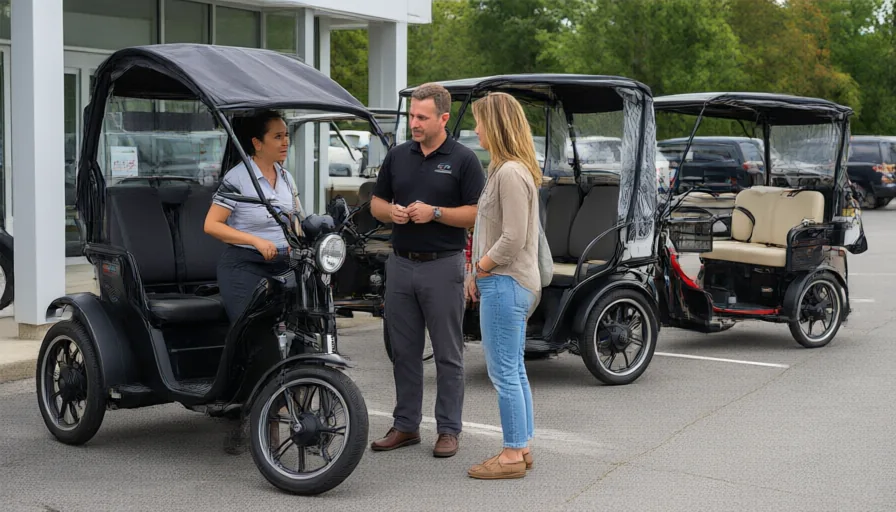
How far can a passenger electric tricycle go on one charge? There is no single number. Do not rely on a headline range figure; ask for range data by battery capacity, passenger load, terrain, speed, temperature and driving style. A figure quoted for one rider on flat ground may not reflect a loaded shuttle in winter. Consumer listings show the spread: one two-adult trike advertises up to 85 miles [Source 1]. Treat that as a best-case consumer figure, not route data.
For dealer evaluation, ask the customer to document daily distance, stop count, average and peak passenger load, grade, climate and peak hours. Request range data by battery capacity and route profile, then demo on a representative route with ballast aboard. This keeps the quote tied to the duty cycle rather than a headline range claim.
Charging time and depot planning
How long does a passenger electric tricycle take to charge? Ask for written charger data: input voltage, output current, and realistic empty-to-full charge time by battery capacity and charger specification. Check whether the depot's overnight charging capacity matches the planned fleet size, including parking, power access at each bay, the actual overnight window, and spare vehicles for units that are charging or down.
Seating layout and passenger comfort
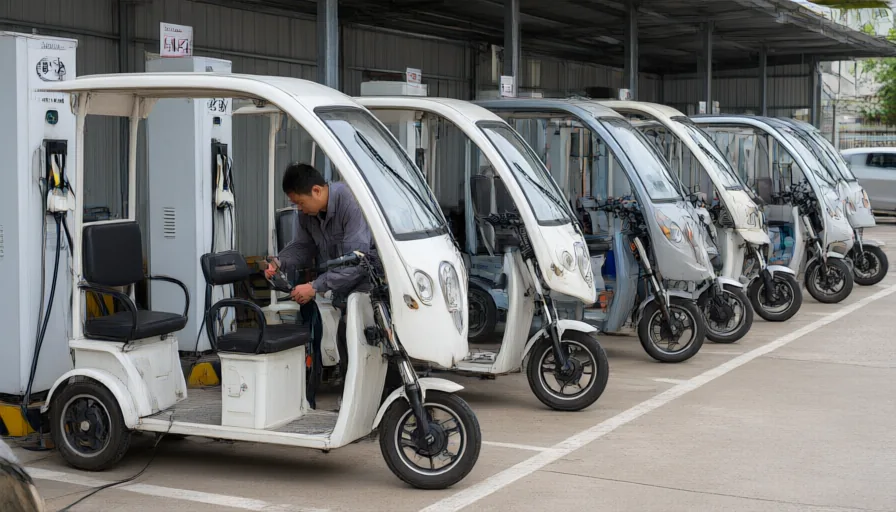
For passenger service, inspect bench versus individual seating, canopy coverage, step-in height, handholds, ingress and egress for older riders, and seat materials that survive sun, rain and daily cleaning. A layout that looks generous on the forecourt may be unsuitable for a passenger with limited mobility, and a leaking canopy can become a dealer service issue. Before any public-road demo, confirm state and municipal rules for passenger-carrying low-speed vehicles; requirements vary by jurisdiction.
Local demand and after-sales coverage
Review demand by segment before committing stock: urban shuttle, rural shuttle, tourism and resort, airport and campus, and walk-in dealership retail. Each may want a different balance of seats, canopy and battery capacity, so one model rarely covers a territory. Before stocking, confirm warranty terms in writing, parts availability and lead times, service documentation, and dealer training. US road-use rules for passenger-carrying low-speed vehicles vary by state and municipality, so verify locally before advertising street use.
Dealer due-diligence table
| Dealer check | Why it matters | Verified fact to confirm |
|---|---|---|
| Manufacturing depth | Stocking volume and lead-time confidence | Founded 1988; eight manufacturing bases, 12 subsidiaries, 3,000+ employees; ~800,000 units annual capacity; stamping, welding, painting and assembly in-house |
| Certification file | Compliance talks with shuttle and campus buyers | CCC, ISO 9001 and National E-Moto certification on file |
| Motor warranty | Warranty exposure on daily shuttle duty cycles | 1-year motor warranty |
| Model breadth | Matching each route segment to a build | Seven passenger models; applications cover urban, rural and tourism routes |
| Customization scope | Dealer branding and climate-specific builds | OEM/ODM for logos, colors, canopies, seats and battery capacity, confirmed before production |
| Sourcing and after-sales | Parts, documentation and training | Central sourcing, quality control, fulfilment and after-sales |
How the line fits a dealership retail stocking plan
TrikeLine vehicles are built by Zhengmin Group, founded in 1988; DINGSEL is operated by U-BYTES. For a dealer, that structure matters when checking consistent builds, a certification file, and one point of accountability for sourcing, quality control, fulfilment and after-sales. Factory-direct customization covers logos, colors, canopies, seats and battery capacity, with scope confirmed before production. For a first general passenger evaluation, the ZM-557 Export Passenger Tricycle is the model to review.
FAQ
How far can a passenger electric tricycle go on one charge?
Range figures should be checked against battery capacity, passenger load, terrain, speed, temperature and driving style, so ask for duty-cycle data rather than a headline figure. The consumer listing above shows about 85 miles for a two-adult trike [Source 1]. For dealer retail, validate on a representative route with realistic ballast before publishing any number.
How long does a passenger electric tricycle take to charge?
Ask for charge time by battery capacity and charger output. Request written charger specifications and a realistic empty-to-full time, then check it against the customer's parking, power access and spare-vehicle plan. Do not quote a charge time you have not seen documented.
Next step
Build a route, depot and seating checklist before requesting quotes. Then contact the Project Director at sales@dingsel.com or +86 151 5606 8111 for the model matrix, certification copies, warranty terms and customization scope.
Sources
- [Source 1] https://maxfoot.bike/products/mf-33-passenger-electric-tricycle-yellow
Useful pages on our site
- Export Passenger Tricycle
- Africa Tuk-Tuk Passenger Electric Tricycle
- Electric Passenger Tricycle
- Export Passenger Electric Tricycle
Talk to DINGSEL · TrikeLine
Request a quote, configuration options or the latest export spec sheet from DINGSEL · TrikeLine. Email sales@dingsel.com | WhatsApp +86 151 5606 8111.