November 19, 2026
Resort Sightseeing Vehicles: Island Buyer Guide
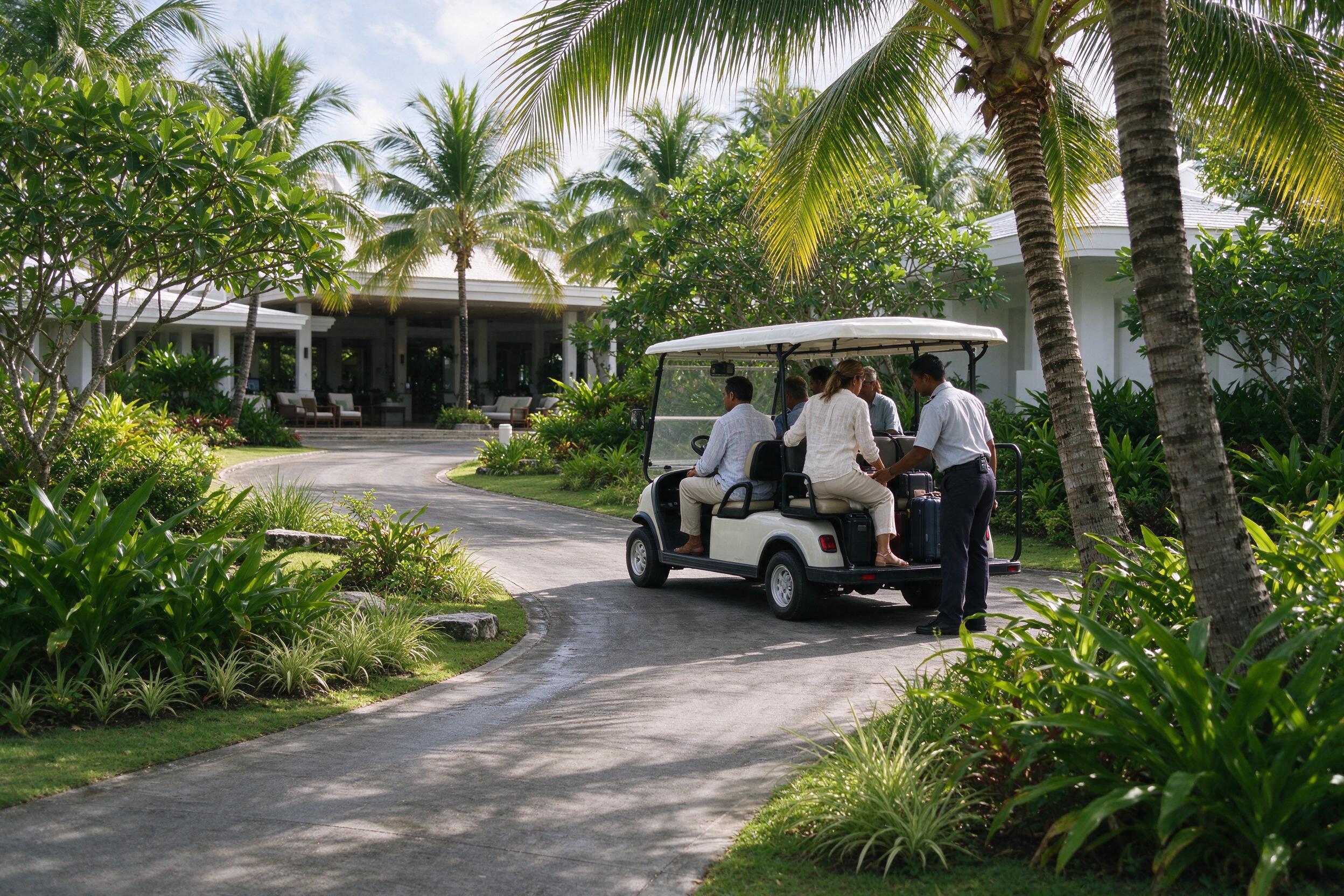
Illustrative example: a Philippine island resort moving guests inside a controlled site — pier to lobby, beach club, villas and service runs. Routes are short but repeat all day in heat, salt air and rain, over narrow paths, mixed paving and packed-sand service tracks, with overnight charging. An electric sightseeing vehicle for island resorts fits that duty when specified around the real loop — seats, cycle time, gradeability, weather protection and charging window — not a headline range figure. Scope: closed-site duty only; consult authorities for public-road legality, registration and type approval.
Overview: electric sightseeing vehicle for island resorts
An electric sightseeing vehicle for island resorts is a low-speed, battery-electric shuttle for guest movement inside a controlled property. The buyer need is a route-matched unit that carries a passenger load, clears arrivals within a set cycle time, handles site gradients and weather, and charges inside the overnight window. Configuration — seating, enclosure, battery, tyres and charging — matters more than model name.
How it works on a resort loop
The vehicle works as a shuttle: it boards at a stop, runs the route at site speed, discharges passengers, and returns or continues. Fleet size comes from peak passengers per hour, full round-trip cycle time including boarding and alighting, and seats delivered per vehicle per hour. Luggage and staff runs share the fleet. Overnight charging sets the daily energy budget. Arrivals come in waves: a boat or coach load reaches the forecourt and the loop must clear it before the next.
What the route demands from the vehicle
Measure the real loop. Heat and rain push weather protection and corrosion resistance up; narrow paths and villa driveways push dimensions and turning space up; gradients and loaded starts test motor power and gradeability. Ask what conditions any range figure was measured under, then compare it with your loop, passenger load and overnight charging window. Comfort is a specification item too: step height, handholds, canopy or enclosure, ventilation and driver sightlines.
Needs analysis: capacity, range, terrain, comfort and utilization
Start with demand, not a brochure. Divide peak passengers per hour by seats actually delivered per vehicle per hour, remembering quoted seating may or may not include the driver. Test range against the real loop: loaded, on your gradients, at site speeds, with stops. Check utilization: how many vehicles hold the cycle, how luggage and staff runs share the fleet, and how downtime affects peak service.
Fit requirements: a buyer checklist
Walk the route with a tape measure and camera before requesting a quote, then check:
- Narrowest access width, tightest turn and available turning space.
- Gradients and loaded starts, including lobby and forecourt ramps.
- Seats required, and whether the driver is counted.
- Battery options, charging time and overnight charging window.
- Motor power and gradeability with a full passenger load.
- Tyre type, ground clearance, brake type, canopy and washdown suitability.
- Spare parts, repair drawings, parts lists and packing documentation.
Treat this list as the electric sightseeing vehicle standard you hold suppliers to. DINGSEL · TrikeLine supplies 41 electric cargo, passenger, agricultural, low-speed sightseeing, off-road and special-purpose vehicles, with OEM/ODM customization subject to confirmation before production.
Import compliance and type approval
Not legal advice. For whether a low-speed sightseeing vehicle may be used on Philippine public roads, and how it would be registered or type approved, consult the relevant Philippine authorities and your own customs and regulatory advisers. Ask suppliers for documentation instead: model-specific specification sheets, electrical diagrams, battery documentation and packing lists, and verify certificate details directly.
Purchase price versus operating cost
Pricing depends on configuration, order quantity and destination; FOB prices are indicative, per unit and exclude batteries, so confirm the quoted configuration. Build the TCO comparison as a framework: purchase price, charging energy, scheduled maintenance, tyres and brake wear, battery replacement, spare-parts logistics and downtime. For Philippine corporate buyers, EVIDA (Republic Act No. 11697) requires industrial and commercial companies, including tour agencies and hotels, to make at least 5% of their fleet electric vehicles under the CREVI framework [Source 1].
Warranty, spare parts and service
Confirm warranty classification before order. Core electrical parts carry a 12-month warranty and lead-acid batteries 6 months; tyres, brakes and lamps are excluded. Overseas support is spare parts with the next order, plus repair drawings, parts lists and video guidance — so the first parts order should travel with the vehicles. TrikeLine buyers should agree who receives drawings and who performs repairs.
Island resort road and beach route constraints
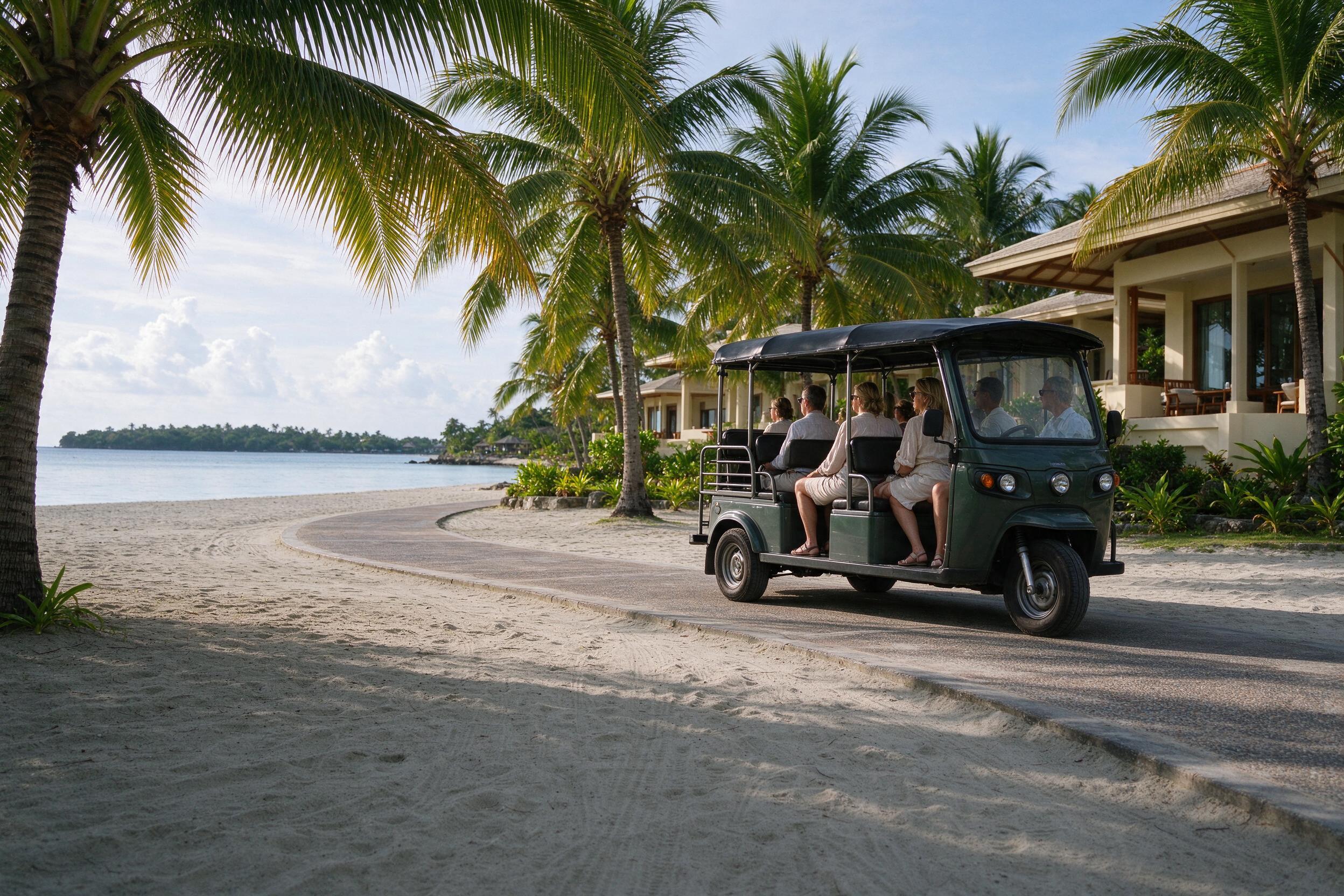
Inside the property, measure the narrowest path, tightest turn and steepest ramp against vehicle dimensions, wheelbase and turning space. On beach routes, plan for packed sand or prepared service paths only; soft sand and saltwater are outside sensible duty, and vehicles should stay clear of the waterline. Check ground clearance, tyre type, enclosure and corrosion protection, and confirm where washdown water drains. Charging should sit under cover, on a measured supply, inside the overnight window.
FAQ
What is the best vehicle for the beach?
For beach-adjacent resort duty, the best vehicle is one specified for prepared service paths and packed sand, with ground clearance, suitable tyres, corrosion protection and washdown-friendly surfaces. Soft sand and saltwater are outside sensible duty.
What should we ask about zero-emission claims?
Ask the supplier to state what it means by ZEV and the documentation it uses for any zero-emission claim, and confirm how it applies to the quoted model.
How should we confirm range for a resort loop?
Treat range as model-specific. Ask the supplier to confirm the quoted model's range under your measured route, passenger load, gradients, site speeds, stops and overnight charging window.
What is the farthest distance an electric car can travel?
There is no single figure: it depends on the model, the battery fitted and how the vehicle is driven. For a resort loop, the useful number is the quoted model's range under your own measured route and load, not a headline maximum.
Is a plane, a vehicle?
Yes. A plane carries people or goods from one place to another, so it is a vehicle in ordinary use. It is not a road vehicle, so it does not change a resort loop specification.
Which electric vehicles are best for long trips?
For long trips, range, charging stops and road speed matter more than they do on a resort loop. A low-speed sightseeing vehicle is specified for short internal loops, so a long public-road transfer is usually handled by a different vehicle class.
Next step
Send the route map, peak passenger counts, charging supply and overnight window, surface photos and measured access widths. Ask for a configuration proposal, specifications, warranty terms and a first spare-parts list. Ask for a quote against that brief; pricing depends on configuration, quantity and destination. Reconfirm closed-site use; for public-road registration or type approval, consult the relevant authorities.
Sources
[Source 1] Republic Act No. 11697 (Electric Vehicle Industry Development Act), s.16 — https://lawphil.net/statutes/repacts/ra2022/ra_11697_2022.html
Useful pages on our site
- High-Pressure Cleaning Vehicle
- Mini Falcon Off-Road Buggy ()
- S1-6 Mini Sightseeing Vehicle ()
- S1 Second-Generation Scenic Vehicle ()
Talk to DINGSEL · TrikeLine
Request a quote, configuration options or the latest export spec sheet from DINGSEL · TrikeLine. Email Helena.jia@dingsel.com | WhatsApp +852 5345 8005.