November 26, 2026
Low-Speed Sightseeing Vehicle Spec for Resorts
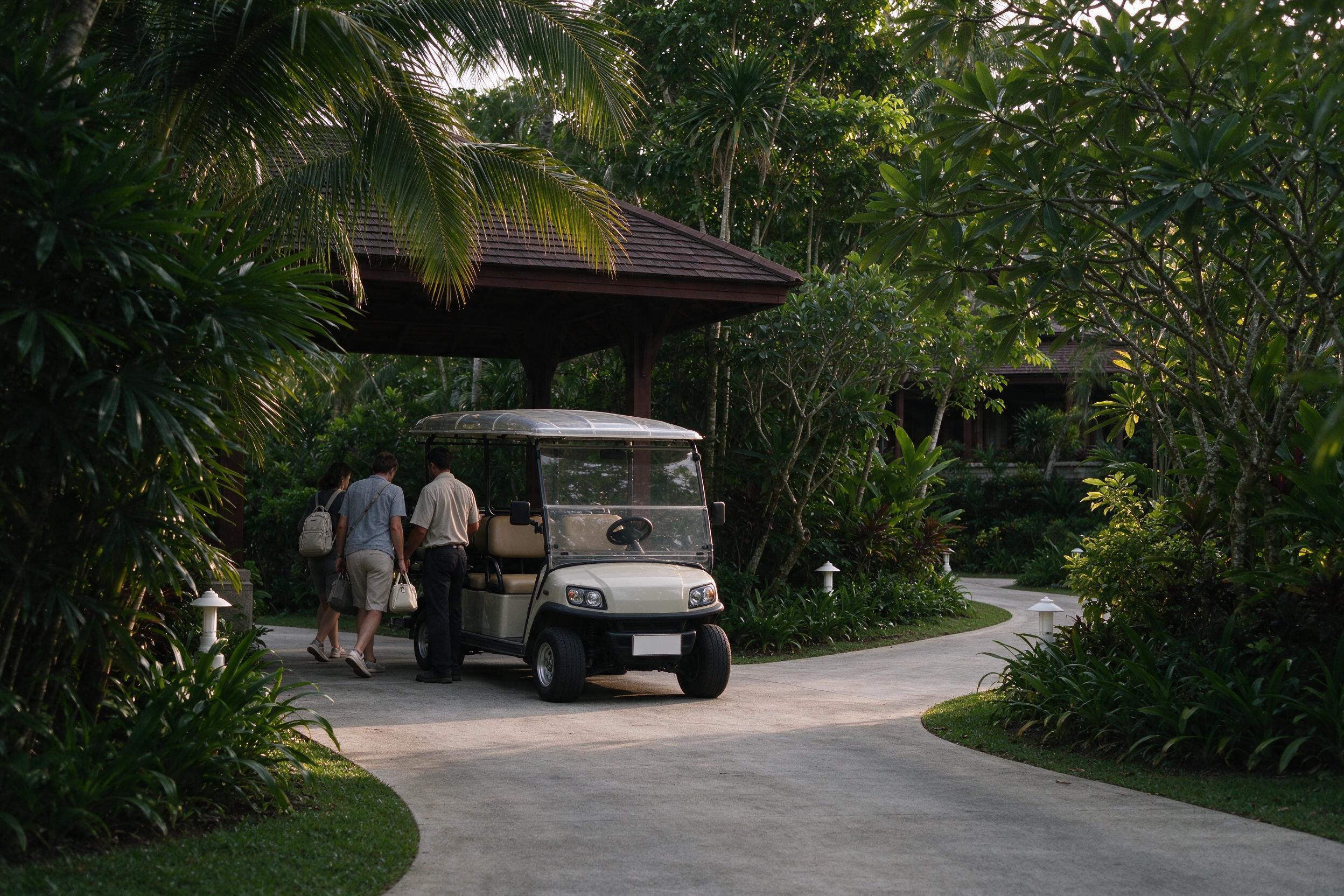
A resort driveway at 7 a.m.: guests with light luggage, a child, two elderly passengers, and a driver starting the third loop before breakfast. The vehicle never leaves private property, runs all day in peak season and charges overnight. That is what an electric sightseeing bus means here — a multi-seat, low-speed vehicle for controlled-site guest transport, not a public-road bus. Public-road operation and registration sit outside this article. Where the fleet question reaches statute, Republic Act No. 11697 requires industrial and commercial companies, including tour agencies and hotels, to keep at least 5% of their fleet electric under the CREVI framework [Source 1].
The decision that matters is whether seats, duty cycle and charging window match one measured guest loop inside a boundary you control.
Daily route length and duty cycle
Electric sightseeing vehicle range is a duty-cycle number, not a brochure number. Build it from the route.
Log one typical day and one peak day: trips, minutes per trip, hours in service, passengers per trip, stops, idle time at the lobby, and the exact charging window. A loop that looks short on a map can consume a full shift once waiting and repeated boarding are counted.
Separate seasons. Peak duty may be double low-season duty, and the charging window may shrink because the vehicle is needed earlier and returned later. Range is model-specific and depends on battery option, load, terrain, speed and weather; no universal figure carries across a range.
Route profile and passenger comfort
Comfort requirements come from the site, not a generic bus specification.
Record surface (paved, gravel, sand-edge), gradients, tight turns, boarding points and internal speed limits. Step height matters more than seat count for elderly guests; canopy and ventilation matter more than trim for beach gear and wet swimwear.
Count the passenger mix, not just seats: adults, children, elderly guests, staff, luggage and beach equipment. A four-wheel low-speed sightseeing vehicle may suit guest transfer between lobby, villas and cabanas, while a mini sightseeing vehicle may suit shorter internal loops with frequent boarding. Confirm seating layout, dimensions and step height from that model's own spec sheet before comparing options.
Seasonal demand and weather protection
Peak season and wet season are two different specifications.
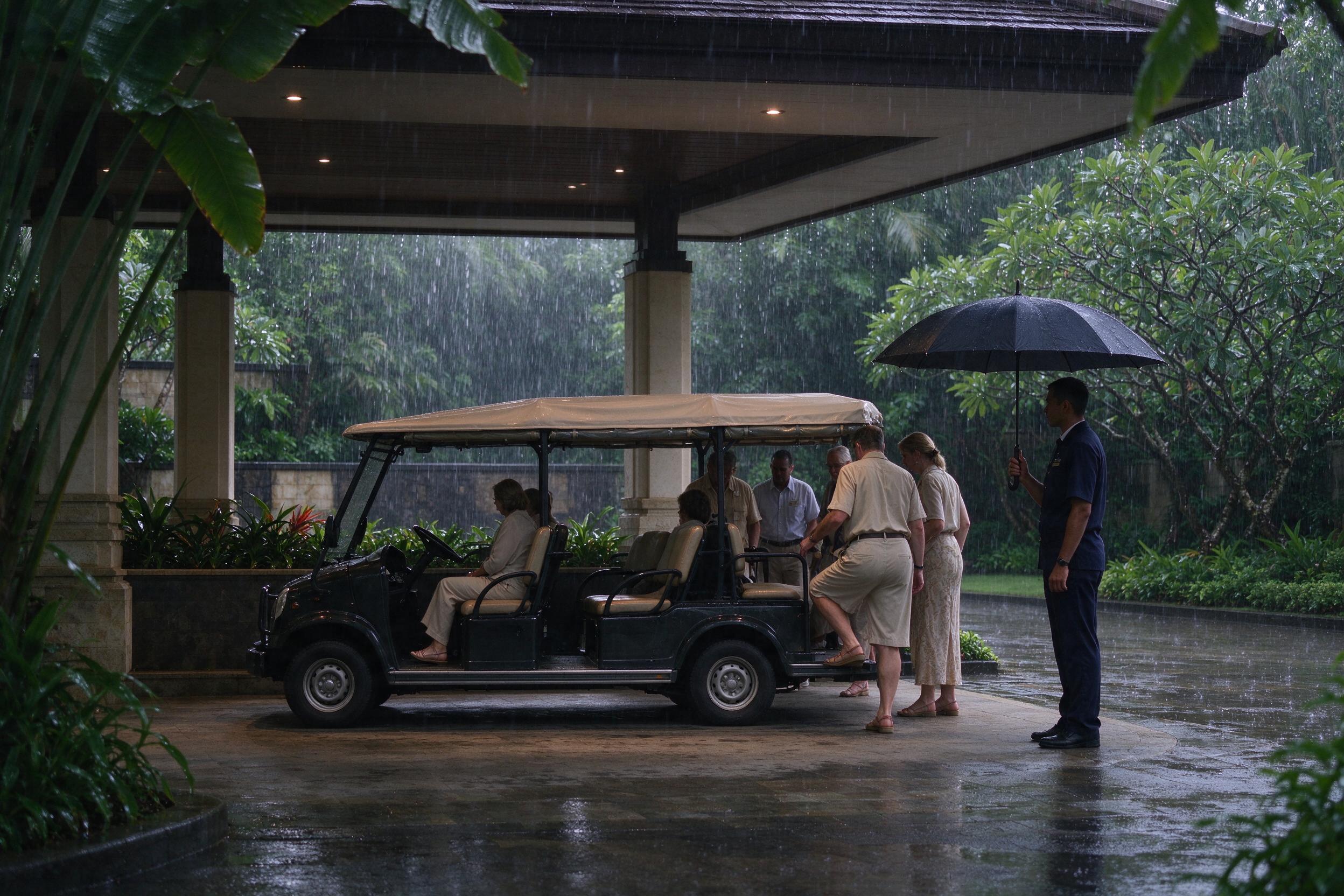
Ask whether one vehicle covers peak demand or whether a spare is needed for charging turnaround and breakdown cover. Ask where guests board in rain — a covered walkway changes the requirement as much as a larger canopy does.
Wind-driven rain, sun exposure on open paths, drainage on resort roads and protection of the charging equipment all belong in the brief. Confirm whether the vehicle is stored under cover overnight and whether boarding points are exposed.
Selection checklist: from needs to checks
Translate the route log into requirements a supplier can confirm in writing.
- Route log for typical and peak days: trips, hours, charging window
- Passenger count per trip and peak load, including luggage and staff
- Surface, gradients, turns, boarding points and speed limits
- Overnight charging window and power at the charging point
- Seating layout, step height, canopy, ventilation, lighting and rain protection
- Battery option matched to measured duty cycle, not a headline figure
- Written configuration confirmation and after-sales terms before production
Verified reference points for the buyer conversation
| Item | What can be confirmed |
|---|---|
| Product scope | 41 electric cargo, passenger, agricultural, low-speed sightseeing, off-road and special-purpose vehicles |
| Applications | Freight and Logistics, Agriculture and Farm, Passenger and Tourism, Industrial and Municipal |
| Customization | Colours, battery capacity, cargo box, seating, logos, instruments and lighting, subject to confirmation |
| Warranty | Core electrical parts 12 months; lead-acid batteries 6 months; wear parts excluded |
| Overseas support | Spare parts shipped with the next order, plus repair drawings, parts lists and video guidance |
| Specifications | Model-specific — range, payload, battery and dimensions are not transferable between models |
Fit and selection: where the category fits — and where it does not
TrikeLine's range includes four-wheel low-speed sightseeing and utility vehicles, mini sightseeing vehicles and related special-purpose vehicles, grouped under Passenger and Tourism among other applications. That is the category to compare against a measured resort loop.
Philippine imports under HS 8711.60 were 868,808 units in 2024, with a low average unit value, showing the channel is dominated by e-bikes and e-scooters rather than four-wheel sightseeing or passenger vehicles [Source 3]. That is not a sightseeing-vehicle market measure.
Adjacent guides: gated community low-speed EV shuttle and mini sightseeing vehicle page; neither implies public-road legality or registration.
FAQ
What are the downsides of electric buses?
Charging dependence, range sensitivity to load, terrain and weather, battery replacement and warranty terms, weather protection, and spare-parts logistics for an imported vehicle. For resort use, match the charging window and duty cycle before choosing a model.
How much does an electric mini bus cost?
Pricing is quote-based, not a fixed list price. It depends on seating layout, battery capacity, canopy and other customization, plus shipping, duties and after-sales terms. Request a written configuration and landed-cost breakdown for the exact route brief.
How much does a fully electric bus cost?
The same quote-based logic applies: battery size, seating, body configuration, charging equipment, delivery and local compliance determine the price. This article covers low-speed private-site sightseeing vehicles, so confirm the scope before comparing public-road bus quotes.
Next step: request a configuration review
Prepare a one-page route brief: site map, daily trips, passenger count, gradients, charging window, weather exposure and preferred seating. Send it to TrikeLine for a configuration discussion. Customization covers colours, battery capacity, cargo box, seating, logos, instruments and lighting, subject to confirmation. Core electrical parts carry a 12-month warranty and lead-acid batteries 6 months, wear parts excluded; overseas support is spare parts with the next order plus repair drawings, parts lists and video guidance. Facility-level certificate documentation is on file — ask the site for verification. Contact: +86 151 56068111, WhatsApp +852 5345 8005.
Sources
- [Source 1] Republic Act No. 11697 (Electric Vehicle Industry Development Act), s.16 — https://lawphil.net/statutes/repacts/ra2022/ra_11697_2022.html
- [Source 3] UN Comtrade, Philippines imports HS 8711.60, 2024 (CIF) — https://comtradeapi.un.org/public/v1/preview/C/A/HS?reporterCode=608&period=2024&cmdCode=871160&flowCode=M
Useful pages on our site
- High-Pressure Cleaning Vehicle
- Mini Falcon Off-Road Buggy ()
- S1-6 Mini Sightseeing Vehicle ()
- S1 Second-Generation Scenic Vehicle ()
Talk to DINGSEL · TrikeLine
Request a quote, configuration options or the latest export spec sheet from DINGSEL · TrikeLine. Email Helena.jia@dingsel.com | WhatsApp +852 5345 8005.