November 16, 2026
Low-Speed Electric Tricycle for Campus Shuttle, PH
A low speed electric vehicle for campus shuttle duty fits one job: moving students and staff around a university-controlled closed loop — gate, academic buildings, library, dormitories and admin offices — with short stops, class-change peaks and overnight depot charging. The key decision is seated capacity against peak flow, weather protection, and whether depot charging matches the battery ordered. This guide covers closed-site duty only and does not imply public-road use.
Campus loop, not a road route: the shuttle scenario
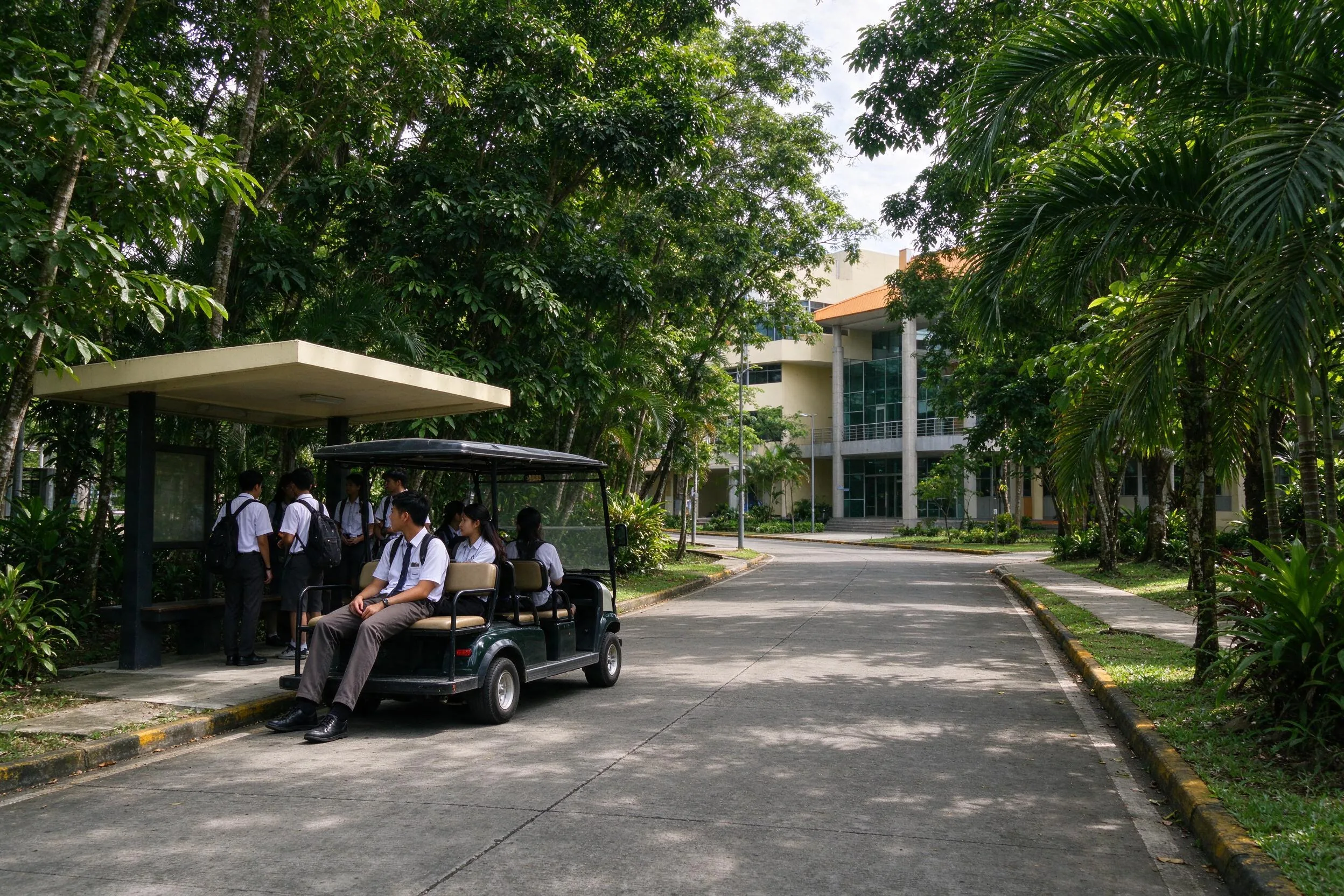
Assume the operator is a university facilities or campus transport office, or a private campus operator handling student circulation. The route is short and repetitive: a few hundred metres between stops, pedestrian crossings, and internal speed limits far below any headline vehicle speed.
That pattern changes the specification. Sixty short trips a day stress steps, seats, brakes and tyres differently from two long ones, while daily distance stays modest and the charging window stays fixed — usually overnight.
Campus loop and student flow constraints
Start with the timetable, not the vehicle. Record peak passengers per run at the busiest class change and compare it with seated capacity; if peak flow exceeds seats, use a staggered schedule, a second unit or a larger vehicle — not standing passengers on an open shuttle.
| What to record | Why it decides the vehicle |
|---|---|
| Peak passengers per run | Seat count versus staggered schedule |
| Stop dwell time and access | Boarding speed at short stops |
| Loop length, grades, pavement | Motor power, tyres, brake type |
| Shade, rain, crossings | Roof, weather protection, mirrors, lighting |
| Depot charging hours and power | Battery capacity and charger configuration |
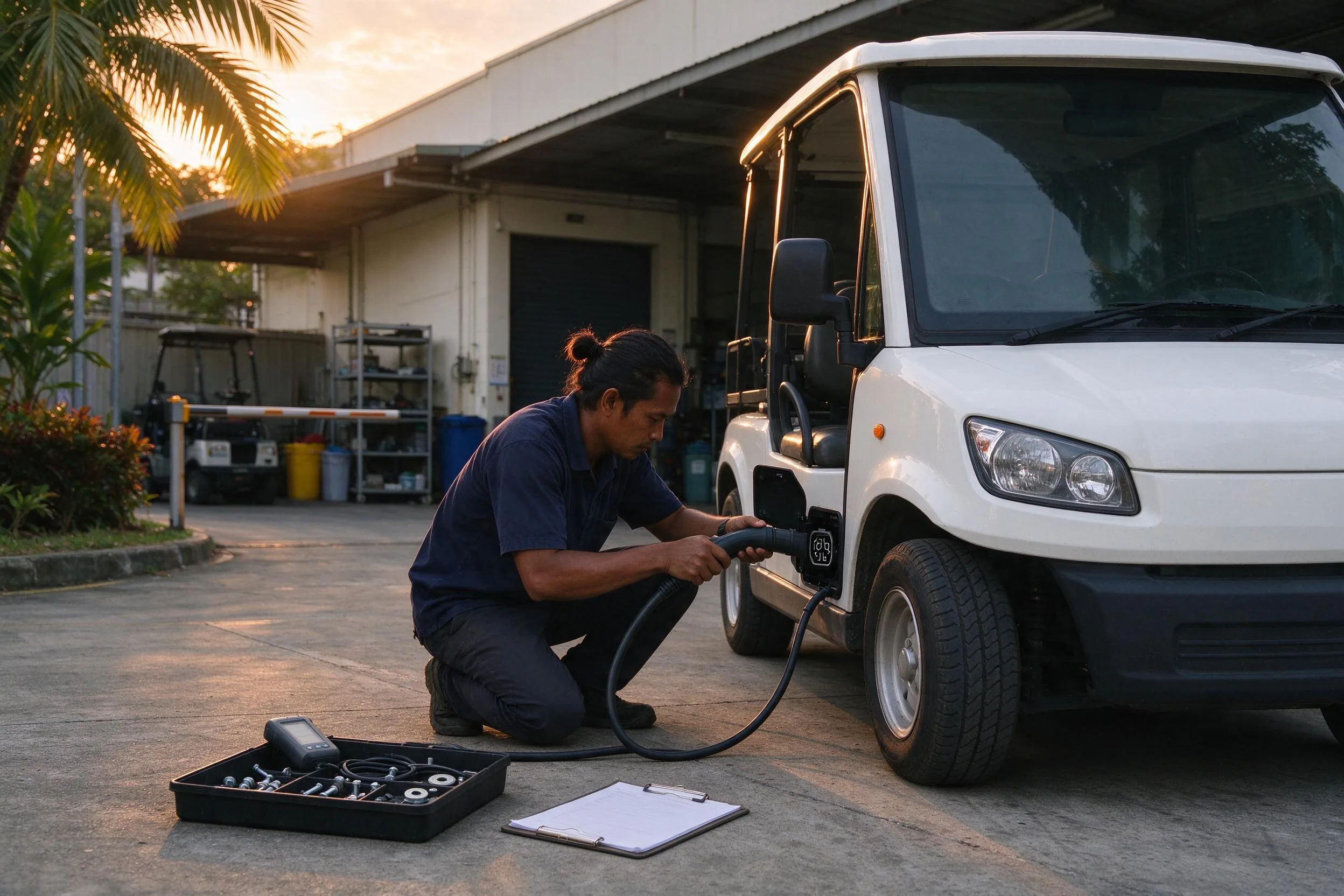
Confirm the overnight charging window and depot power before shortlisting battery capacity. Range you cannot recharge overnight is a schedule risk, not a reserve.
Import compliance and type approval
Do not assume public-road admissibility for electric tricycles or low-speed vehicles in the Philippines. This guide is limited to closed-site duty, and nothing here should be read as approval for public roads.
Ask the supplier what documents exist for the model, then confirm import questions with your customs broker or counsel; a supplier document is not a government approval. Certificate claims should stay at facility level: a facility-level certificate collection image is on file, and individual certificate details are not separately verified.
Treat purchasing as order-specific because configurations and destinations vary. Philippine imports under HS 8711.60 reached 868,808 units in 2024, a channel dominated by e-bikes and e-scooters rather than four-wheel passenger vehicles [Source 3].
If the campus is run by a commercial operator such as a hotel, tour agency or industrial company, EVIDA (RA 11697) requires at least 5% of the fleet, owned or leased, to be electric under the CREVI framework [Source 1]; confirm applicability with counsel.
Fit and configuration
TrikeLine offers 41 electric cargo, passenger, agricultural, low-speed sightseeing, off-road and special-purpose vehicles. For this scenario, match the category to the loop, then request a configured quotation. FOB prices are indicative, per unit and exclude batteries, so a headline figure is not comparable until battery, seating, charger and support scope are matched.
Purchase price versus operating cost
Build a TCO framework: acquisition, charging, scheduled maintenance, tyres and brakes, battery replacement, spare-parts shipping and downtime. On a daily-use campus asset, downtime is often the largest hidden line, because a shuttle out of service at 7 a.m. displaces students onto a schedule with no spare capacity.
Compare price only after matching battery, seating, weather protection and support scope; spare-parts availability and guidance can turn a low FOB price into higher operating cost.
Warranty, spare parts and service
Core electrical parts carry a 12-month warranty and lead-acid batteries 6 months; wear parts such as tyres, brakes and lamps are excluded. Overseas support is spare parts shipped with the next order, plus repair drawings, parts lists and video guidance.
Ask three questions before ordering: what is on the parts list for this configuration, who repairs locally, and how long the shuttle can stay in service between parts shipments. Parts availability belongs in the same checklist as seat count.
FAQ
What is considered a low speed electric vehicle?
In the Philippines, legal treatment depends on EV policy and import classification rather than a single label [Source 1] [Source 3]. For campus planning, treat it as a controlled-site passenger vehicle category and verify the model's specifications and permitted use.
What is the best LSV for a campus shuttle?
There is no market-wide best. Choose by route, speed, passenger flow, charging, compliance and support. If a six-passenger, four-wheel disc-brake configuration is needed, the Q10 family may be a candidate; confirm model-specific specifications before ordering.
What is the difference between an LSV and a golf cart?
In the Philippines, legal treatment depends on vehicle category and import classification [Source 1] [Source 3]. Compare seating, weather protection, brakes, tyres, lighting, cargo options and boarding access rather than the label; neither label is a public-road approval here.
How much does a campus shuttle LSV cost?
No current price is supplied here. For any LSV, pricing depends on configuration, order quantity and destination, so request a configured quotation. Do not compare vehicles on a headline price without matching battery, seating, charger and support scope.
How much does a GEM car cost?
No verified GEM price is supplied here. Like other campus shuttle LSVs, cost depends on configuration, order quantity and destination; request a configured quotation and compare battery, seating, charger and support scope.
Next step: build a campus shuttle requirement sheet
Collect the loop map, stop list, peak passenger count, charging window, pavement and grade notes, then request a configured quotation and documentation package. TrikeLine can support this.
Contact: Helena.jia@dingsel.com, +86 151 56068111, WhatsApp +852 5345 8005.
Sources
- [Source 1] Republic Act No. 11697 (Electric Vehicle Industry Development Act) — https://lawphil.net/statutes/repacts/ra2022/ra_11697_2022.html
- [Source 3] UN Comtrade, Philippines imports HS 8711.60, 2024 — https://comtradeapi.un.org/public/v1/preview/C/A/HS?reporterCode=608&period=2024&cmdCode=871160&flowCode=M
Useful pages on our site
- High-Pressure Cleaning Vehicle
- Mini Falcon Off-Road Buggy ()
- S1-6 Mini Sightseeing Vehicle ()
- S1 Second-Generation Scenic Vehicle ()
Talk to DINGSEL · TrikeLine
Request a quote, configuration options or the latest export spec sheet from DINGSEL · TrikeLine. Email Helena.jia@dingsel.com | WhatsApp +852 5345 8005.