November 23, 2026
Factory Shift EV: Low-Speed Shuttle Guide
A Philippine factory or industrial park operator moves workers between parking, canteen, production halls, assembly areas, or gates inside a boundary the operator controls. Routes are short but repeated, with peak demand at shift change, paved or mixed surfaces, heat and rain, and limited space for charging and dispatch. In this setting, a low speed electric vehicle for factory shift duty is best understood as a closed-site passenger shuttle, not a public-road bus, and the key decision is matching seats, canopy, depot charging, and dispatch spacing to the shift schedule, controlled gates, marked boarding points, and predictable turnaround times inside the site. TrikeLine positions four-wheel low-speed passenger/sightseeing vehicles for this internal duty, with customization confirmed before production and after-sales planning before deployment.
Needs and Pains for Closed-Site Worker Movement
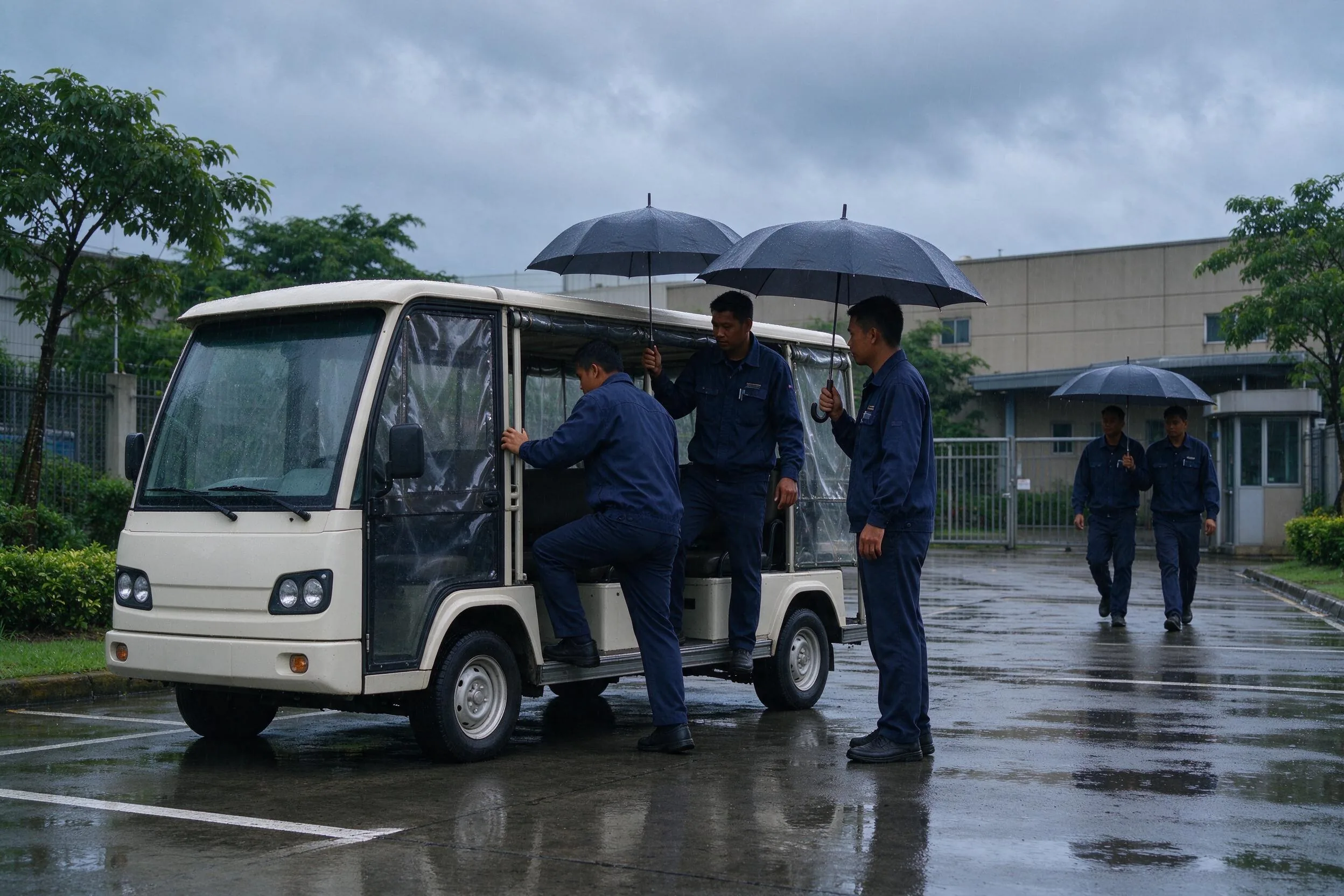
The operator’s pain is not distance; it is predictability. Short internal loops can fail when shift change compresses many trips into minutes, when rain slows boarding, when seats and handrails are not matched to worker flow, or when a charging bay is too far from the gate. A low-speed electric vehicle for factory shift duty should be evaluated as a closed-site shuttle system, with route, depot, weather and maintenance checks completed before procurement.
Shift-change peak load and dispatch
Peak load is a dispatch problem. The buyer should compare workers per shift, trip time, waiting space and turnaround time. If queues form at gates, canteens or production halls, add trips or spacing rather than assuming more speed solves the bottleneck.
Seating layout and passenger comfort
Low speed electric vehicle seats should be checked against boarding order, floor space, handrails and standing risk. Seat count is not the only capacity measure; wet floors, narrow steps and unclear entry points can slow each trip and reduce safe usable capacity.
Charging time and depot planning
A low speed electric vehicle depot needs a controlled charging bay, charger compatibility, battery data and a shift schedule that allows overnight or break-time charging. Without model-specific battery and charger information, availability cannot be assumed.
Canopy and weather protection
Philippine heat and rain change usable capacity. A canopy helps, but buyers should check side protection, drainage, lighting, shaded waiting areas and whether boarding stays dry when workers move from parking to canteen. For low speed electric vehicle rain duty, covered entry points and non-slip floors matter as much as the roof. Weather protection should be planned with the route, not added after the first wet shift.
Factory and Industrial Park Shift Shuttle Fit
For closed-site worker movement, four-wheel low-speed passenger/sightseeing vehicles can fit short internal loops when covered boarding, predictable seating and a compact footprint are required. The category can be planned around shift waves, with route maps, waiting areas and charging bays treated as site infrastructure rather than assumptions. TrikeLine can arrange factory-direct customization of colours, battery capacity, seating, logos, instruments and lighting options, subject to confirmation before production. Do not apply one model’s range, payload, battery, dimensions or charging time to another model; request model-specific documentation and confirm that duty remains inside the operator’s controlled boundary and avoid any implication of public-road admissibility for planning, procurement and site acceptance before deployment.
Requirements checklist for closed-site planning
| Requirement | What the buyer should check | Verified planning point |
|---|---|---|
| Seats and passenger layout | Number of workers per shift, boarding order, seat count, handrails, floor space | Seating layout can be customized subject to confirmation before production |
| Rain and heat protection | Canopy, side panels, drainage, shaded waiting area, lighting options | Lighting and related options can be customized subject to confirmation before production |
| Depot and charging | Charging bay location, overnight charging, charger compatibility, battery capacity, shift schedule | Battery capacity can be customized subject to confirmation before production |
| After-sales readiness | Wear parts, spares, drawings, video guidance, warranty scope | Core electrical parts carry a 12-month warranty; lead-acid batteries carry 6 months; wear parts are excluded; overseas support includes spare parts shipped with the next order plus repair drawings, parts lists and video guidance |
FAQ
What is considered a low speed electric vehicle?
For this guide, a low-speed electric vehicle is a four-wheel electric passenger or utility vehicle used for short internal duty inside a controlled boundary. Exact specifications to confirm include speed, dimensions, battery, charger, seating, canopy and site rules. Do not assume public-road admissibility.
What is the best LSV on the market?
No verified single best LSV exists for Philippine factory shifts. Fit depends on worker count per shift, route length, surfaces, rain and heat exposure, depot space, charging plan and documentation. A category approach is safer than a universal product claim.
How much does LSV cost?
Pricing depends on configuration, order quantity and destination. FOB prices are indicative, per unit and exclude batteries. Buyers should confirm the exact vehicle specification, battery option, charger, customization and after-sales terms before requesting a final quotation. No fixed price should be assumed from a generic model name.
How long does a passenger electric tricycle take to charge?
No universal charge time is supplied. Charge time depends on battery capacity, charger compatibility, temperature, state of charge and usage. For factory shift duty, request model-specific battery and charger data, then plan overnight or break-time charging in a controlled depot.
After-sales and documentation
Plan after-sales before deployment. Core electrical parts carry a 12-month warranty; lead-acid batteries carry 6 months; wear parts are excluded. Overseas support includes spare parts shipped with the next order plus repair drawings, parts lists and video guidance. A facility-level certificate collection image is on file; individual certificate details are not separately verified, so buyers should check the site for current verification.
Next step
Next, share a route map, shift schedule, passenger capacity target, charging bay constraints, and documentation needs. TrikeLine can help translate those closed-site requirements into a four-wheel low-speed passenger/sightseeing vehicle plan, with customization and after-sales terms confirmed before production. Use the [Low-Speed Electric Tricycle for Campus Shuttle, PH](/low-speed-electric-tricycle-for-campus-shuttle-ph) page as a closed-site shuttle planning reference. Do not assume public-road admissibility; keep planning inside controlled gates, internal roads and private boarding areas.
Sources
- [Source 1] https://lawphil.net/statutes/repacts/ra2022/ra_11697_2022.html
Useful pages on our site
- High-Pressure Cleaning Vehicle
- Mini Falcon Off-Road Buggy ()
- S1-6 Mini Sightseeing Vehicle ()
- S1 Second-Generation Scenic Vehicle ()
Talk to DINGSEL · TrikeLine
Request a quote, configuration options or the latest export spec sheet from DINGSEL · TrikeLine. Email Helena.jia@dingsel.com | WhatsApp +852 5345 8005.