October 17, 2026
Verify UL 2849 Before Importing a Passenger Trike
In US micromobility sourcing, UL 2849 has shifted from a differentiator to a baseline expectation: certification now shapes which product configurations a buyer can order and which sales channels will accept them [Source 1]. The bar for importing passenger tricycles to the USA has moved with it.
That shift creates a specific problem for buyers sourcing overseas. When the trike is built 7,000 miles away, the certificate — not the brochure — is the product. A supplier writing "the battery is UL certified" is not stating that the complete electrical system holds a system-level UL 2849 certificate [Source 1]. The gap between those two sentences is where deposits get lost.
Below is a five-step verification checklist — certificate scope, NRTL accreditation, charger inclusion, document-to-order matching, and supplier due diligence. It works on any overseas supplier, and it is the same test this article applies to the catalog at the end.
What UL 2849 Actually Certifies — and What It Doesn't
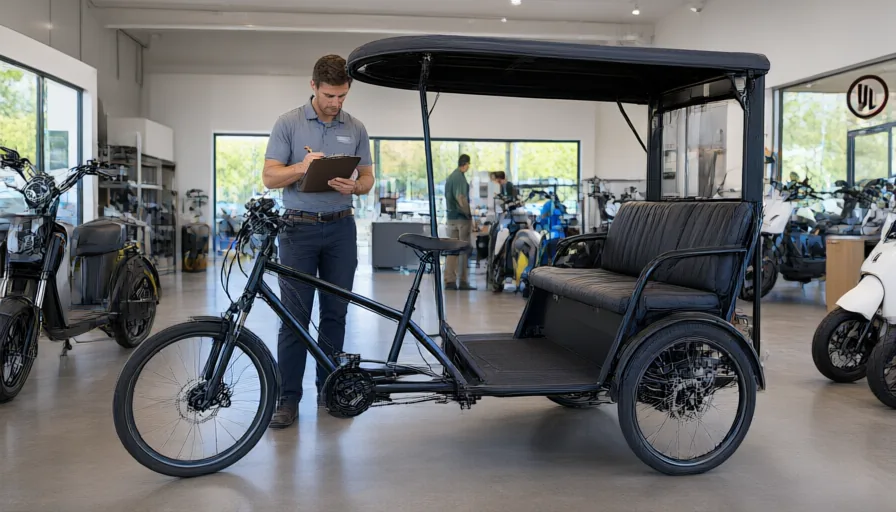
UL 2849 is the Standard for Electrical Systems for eBikes. It provides electrical and fire safety certification at system level by examining the electrical drive train system, battery system, and charger system combinations [Source 2]. In practice, that spans the battery, charger, motor, and wiring as one evaluated unit [Source 3].
Two scope limits matter for trike buyers. First, the standard is written for e-bikes and pedelecs. Second, its hazard evaluation covers the electrical systems themselves — it does not evaluate the operator's ability to maintain control while riding [Source 2]. A three-wheeled passenger vehicle sits adjacent to this scope — which is precisely why you confirm how the standard was applied to your configuration instead of assuming it carries over. Buyers will also meet UL 2271, the related battery-level standard that sits alongside UL 2849 in B2B sourcing guides [Source 1]; keeping "battery standard" and "system standard" separate is the core skill of this article.
Why has this become a baseline? E-bike battery fires have caused property damage, injuries, and deaths, drawing multiple CPSC warnings, recalls, and safety guidance on micromobility [Source 3]. Certification failures contributed to the downfall of at least one major brand [Source 3]. For a US buyer, UL 2849 now functions as a market-access document — not a marketing badge [Source 1] — and as a question your insurer will expect you to answer.
"UL Certified" Can Mean Four Different Things
UL certifications attach to defined products, components, standards, and scopes. Individual components — a battery pack, for example — can each carry their own certification [Source 6]. Component certification does not equal system certification [Source 1] — and supplier language rarely volunteers the difference. Table 1 decodes the four claims you are most likely to hear.
Table 1 — Supplier claim decoder
| What the supplier says | What it actually tells you | What to request before ordering |
|---|---|---|
| "The battery is UL certified" | Likely component-level evaluation; scope undefined | Which standard, which level, and the certificate number |
| "Tested to UL standards" | A test report — not third-party certification with factory follow-up | The certificate itself |
| "The charger has its own safety mark" | Charger certified alone; may not match the shipped unit | Whether the charger sits inside the system certificate |
| "UL 2849 certified" | The right answer — only if the certificate lists your exact model and configuration | The full certificate plus an NRTL check |
The practical buyer question is therefore not "does it have UL?" It is: which exact configuration was evaluated, under which standard, by which certification body — and does the paperwork match the vehicle you are actually ordering [Source 1]?
The Five-Step Pre-Import Verification Checklist
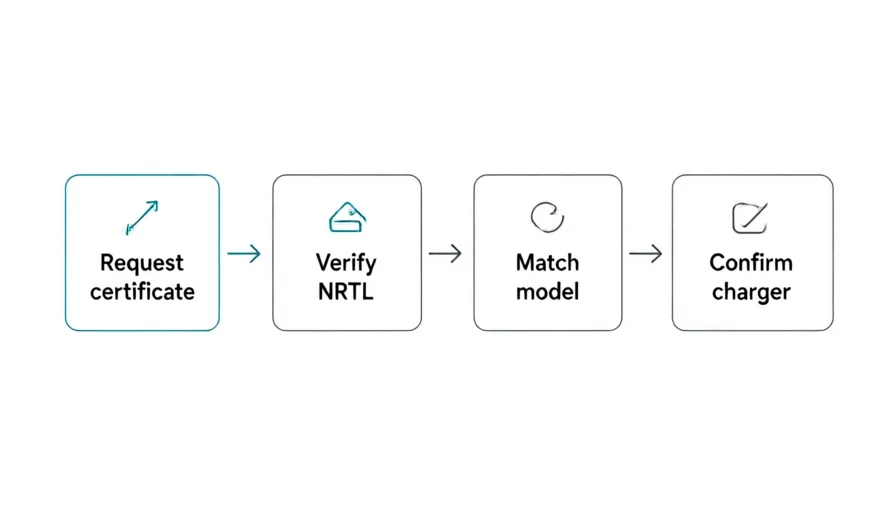
Each step follows the same pattern: what to ask, what a good answer sounds like, and what should stop you.
Step 1 — Pin down the standard and the exact configuration
Certificates tie to defined products and scopes [Source 6]. Ask: "Which standard does this certificate cover, and which exact configuration was evaluated — model, battery specification, charger?" A good answer names the standard, the certificate number, and the tested configuration without hesitation. A bad answer is a brochure page, or a scope that doesn't match what you are ordering. This step matters most when you customize: battery capacity is a standard OEM/ODM option on export trikes, and a battery swap can take you outside the certified scope [Source 1]. If you order a different pack than the one tested, the certificate no longer describes your vehicle.
Step 2 — Confirm the certifying body is an OSHA-recognized NRTL
US third-party certification carries weight when the issuing laboratory appears on OSHA's list of Nationally Recognized Testing Laboratories (NRTLs). The check is simple: obtain the certificate number, look up the issuing lab on OSHA's published NRTL list, and confirm the mark on the product matches the certificate. A good answer gives you a verifiable number from a lab on the list. A bad answer is "UL-approved" with no number, or a lab you cannot find on OSHA's list.
Step 3 — Check the charger is inside the certificate
UL 2849 evaluates the battery and charger as a system combination [Source 2]. Ask: "Is the charger model shipped with my fleet the one covered by the certificate?" A good answer shows the charger model on the certificate matching the packing list. A bad answer — and a common one — is a charger substituted at packing because the certified unit was out of stock. A substituted charger breaks the system match, and with it the certification's meaning.
Step 4 — Match documents to the proforma invoice
Before releasing a deposit, put the certificate beside the proforma invoice and compare line by line: model number, battery specification, charger model. The documentation must match the vehicle actually ordered [Source 1]. A good answer: every field aligns, and any customization is reflected in an updated certificate or a written scope statement from the certifying body. A bad answer: "the certificate is for our standard model — yours is the same thing." "Same thing" is not a document.
Step 5 — Run supplier due diligence
Ask for factory-level evidence: which processes are handled in-house, which company certifications are on file, what annual capacity is, and what the warranty covers — in writing, not in a sales call. Then ask the question that decides your shipment: how are US-bound configurations certified? Get the agreed certification scope confirmed in writing before production. TrikeLine, for example, confirms factory-direct OEM/ODM scope — logos, colors, canopies, seats, battery capacity — in writing before production; treat written scope confirmation as the minimum benchmark with any supplier.
Pause the deposit if you see any of these red flags:
- Certificates with blanked model fields
- A "test report" offered instead of a certificate
- Reluctance to name the certifying body
- A charger swapped at packing
Why This Checklist Now Shapes US Fleet Economics
Channel access comes first: certification determines which sales channels and markets will accept a product [Source 1]. Before committing to a fleet order, ask each intended channel — dealer networks, rental operators, campus or municipal procurement — what documentation it requires, because requirements differ by market and jurisdiction.
Insurance comes second. Certification is a question fleet insurers may raise when pricing cover: ask your broker before ordering whether an uncertified fleet would face higher premiums, exclusions, or declined cover, and get the answer in writing. Treat your electric trike battery certification file as part of your insurance file from day one.
Then total cost of ownership. Weigh the certification premium against fire and loss risk, downtime, insurance friction, and resale value. A certificate is cheaper than a single garage fire or a stranded shuttle route.
Urban shuttles, campus and airport loops, and tourism fleets carry different exposure profiles — passenger counts, charging patterns, duty cycles — but all three face the same insurer and regulator questions. The checklist answers them once, per configuration.
Verified Facts, Configuration-Level Documentation
This article holds every supplier to one standard, so it ends by applying the same test to the brand behind this guide. The certifications documented for the manufacturer are CCC, ISO 9001, and National E-Moto certification (supplier dossier). No UL 2849 claim is made here for any model in the line-up: US buyers who require it should request the certificate for their exact US-bound configuration, with the customization scope confirmed in writing before production.
Be equally clear about what the on-file credentials are not. CCC is a Chinese market certification and ISO 9001 a factory quality-system credential; neither substitutes for US-destination certification such as UL 2849.
| Credential on file | What it is | What it tells a US buyer |
|---|---|---|
| CCC | Chinese market certification | Covers domestic China market access; not a US-destination certification |
| ISO 9001 | Factory quality-management credential | Signals process consistency; not a product safety approval |
| National E-Moto certification | Documented in the supplier dossier | A manufacturer credential; confirm its scope with the supplier |
| UL 2849 | US system-level e-bike electrical safety standard [Source 2] | What US channels and insurers may ask for — request it per configuration |
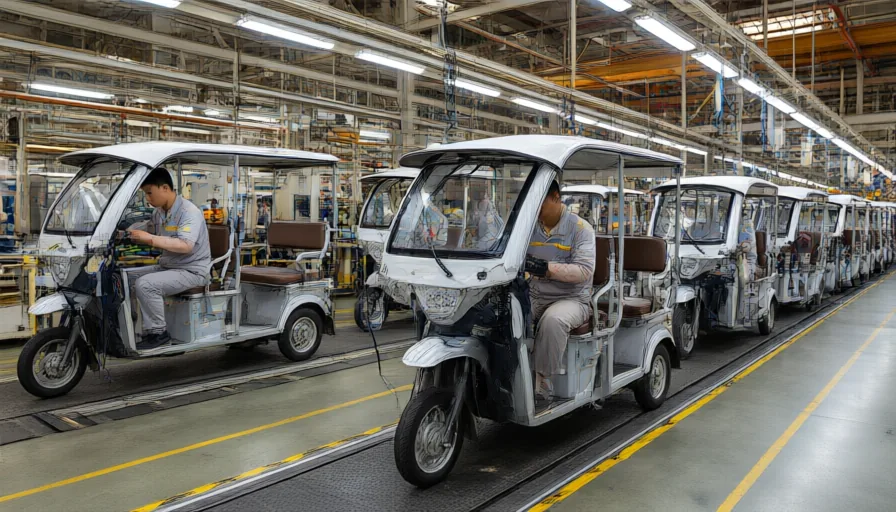
TrikeLine connects buyers with a verified manufacturer established in 1988. Zhengmin Group Vehicle Co., Ltd. of Xuzhou, Jiangsu operates eight manufacturing bases and 12 subsidiaries with more than 3,000 employees and an annual tricycle capacity of about 800,000 units (manufacturer-stated). Stamping, welding, painting, and assembly are all in-house, and the motor warranty is 1 year. The export catalog carries seven passenger trike models — entry-level, multi-seat, and tuk-tuk-style configurations — with applications across Urban, Rural, and Tourism routes.
To discuss certification documentation for your configuration, contact the Project Director at sales@dingsel.com or +86 151 5606 8111.
Quick Answers (FAQ)
What does UL 2849 mean?
It is the UL Standard for Electrical Systems for eBikes — a system-level evaluation of the electrical drive train, battery, and charger combinations [Source 2].
How do I check if a trike is UL certified?
Get the certificate itself, not a brochure claim. Confirm the issuing lab appears on OSHA's NRTL list, then match the model and configuration on the certificate to your order [Source 1][Source 2].
How can I tell if the battery itself is certified?
Ask which standard and which level the certificate covers — the battery alone or the full system. Component certification is separate from system certification [Source 6].
Does UL 2849 apply to passenger tricycles?
The standard is written for e-bikes and pedelecs [Source 2]. For a three-wheeled passenger vehicle, confirm with the supplier and the certifying body exactly what the certificate covers.
The Baseline Has Moved
The US baseline is no longer a component mark or a brochure badge; it is system-level certification, verified per configuration. Request the certificate, check the NRTL list, match the charger, match the order — then release the deposit.
Our word is our bond — globally selected.
Sources
- [Source 1] EMOKO Tech — "UL 2849 E-Bike Certification: B2B Buyer Guide" (emokotech.com/ul-2849-ebike-certification)
- [Source 2] UL Solutions — "E-Bikes Certification: Evaluating and Testing to UL 2849" (ul.com/services/e-bikes-certificationevaluating-and-testing-ul-2849)
- [Source 3] Retrospec — "UL-Certified eBikes: What It Means & Why It Matters" (retrospec.com/blogs/gear-guides/ul-certified-ebikes-what-the-certification-means-and-why-it-matters)
- [Source 6] Epoch Batteries — "UL Certification Numbers Explained for Lithium Batteries" (epochbatteries.com/pages/ul-certification-numbers-explained)
Useful pages on our site
- Export Passenger Tricycle
- Best-Selling Export Passenger Tricycle
- Africa Tuk-Tuk Passenger Electric Tricycle
- Electric Passenger Tricycle
Talk to DINGSEL · TrikeLine
Request a quote, configuration options or the latest export spec sheet from DINGSEL · TrikeLine. Email sales@dingsel.com | WhatsApp +86 151 5606 8111.